
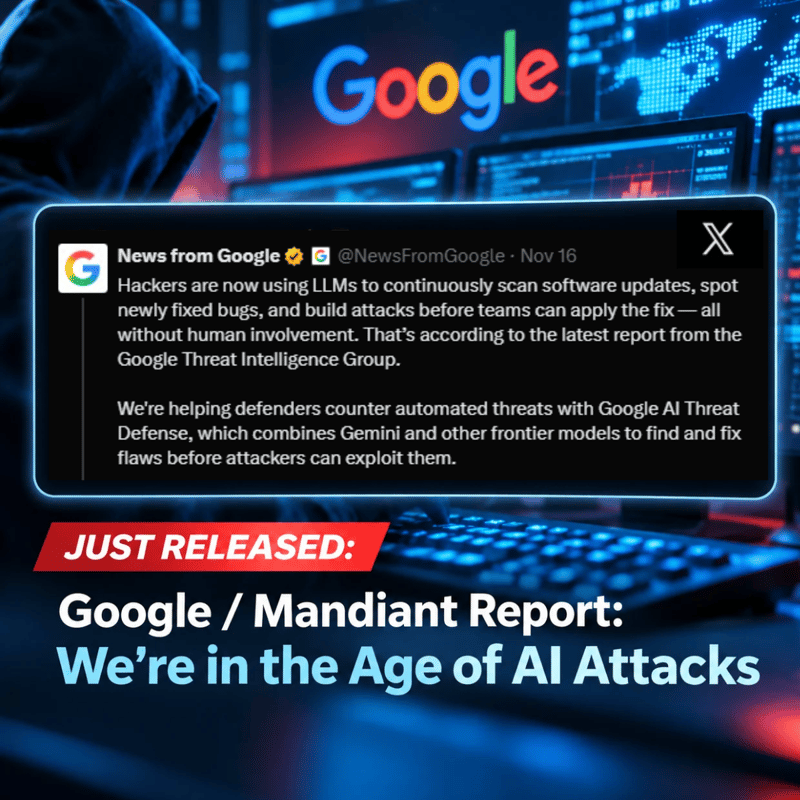
 Recent technology disruptions highlight just how dependent we are on complex systems. A new Google report shows how AI is accelerating cyberattacks - and why all of us, including small businesses, need smarter defenses.
What a week for technology!
First, Microsoft 365 experienced a major outage. Then, on Friday, the FAA issued a ground stop, disrupting air travel. On Monday, banking customers experienced service disruptions, and on Tuesday, Apple services had problems.
These incidents certainly got everyone's attention.
To be clear, these events haven't been established as cyberattacks, and there's no evidence they were connected. Some were attributed to ordinary technical problems.
But together they illustrate something important about the increasingly complex and interconnected world we're living in. Add in a scheduled nationwide test of the Federal Emergency Alert System, and it's easy to see how uncertainty, stress, and rumors can quickly take hold. When so much of our daily lives depends on technology, even unrelated disruptions can leave people wondering what's really going on.
We've become incredibly dependent on technology, and the systems supporting our daily lives are extraordinarily complex.
Many of these systems have been developed over decades, with newer technologies layered on top of older ones. They're interconnected in ways that can be difficult to fully understand. In some cases, no single person understands how everything works together from beginning to end.
When something goes wrong, the consequences can spread quickly.
Now consider what happens when cybercriminals deliberately target that complexity - and use artificial intelligence to accelerate their attacks.
I believe we're reaching a significant inflection point.
AI Is Changing the Speed of Cyberattacks
On November 16, Google's Threat Intelligence Group and Mandiant released an important new report: Agentic Threat Activity Crosses a Significant Threshold.
The report describes a major shift in cybersecurity. Cybercriminals are increasingly using AI to find vulnerabilities, automate attacks, and exploit weaknesses at machine speed.
And Google isn't the only company raising the alarm.
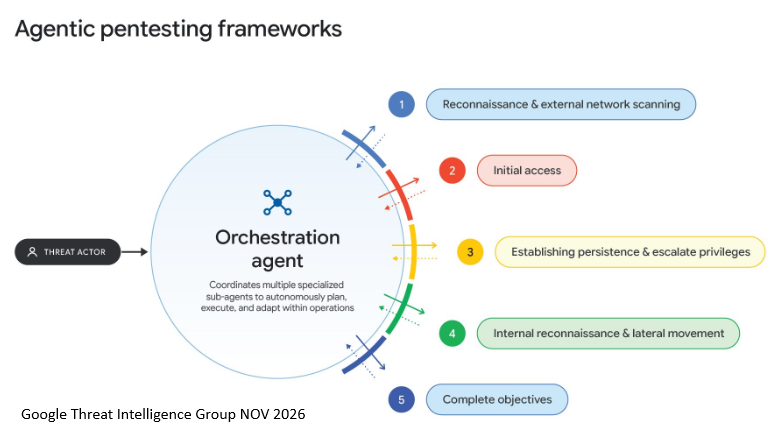
In its 2026 Digital Defense Report, Microsoft reported nearly 40,000 publicly disclosed software vulnerabilities in just the first six months of 2026, with approximately 72,000 projected for the full year.
Microsoft also reports that the median time between discovering a vulnerability and turning it into a working attack has dropped below 24 hours.
Think about what that means for the people responsible for keeping technology safe: More vulnerabilities to investigate. More security updates to evaluate. Less time to respond.
And all of this is happening in technology environments that are already enormously complex.
This is the inflection point: Our dependence on technology keeps growing, the systems themselves are increasingly complicated, and AI is dramatically accelerating the threats against them.
We can't expect yesterday's approach to cybersecurity to keep pace indefinitely.
The Stockdale Paradox: Facing Reality Without Fear
There's a concept I've been thinking about called the Stockdale Paradox, popularized by Jim Collins in his book Good to Great.
Admiral James Stockdale survived more than seven years as a prisoner of war in Vietnam. His philosophy was to maintain unwavering faith that you will ultimately prevail while confronting the brutal facts of your current reality.
I think that's exactly the right mindset for cybersecurity today.
At Ekaru, we don't believe in using fear, uncertainty, and doubt(otherwise known as FUD) to convince small businesses to invest in cybersecurity. But we also don't believe in pretending everything is fine. Cybercriminals have powerful new capabilities. Ignoring that reality won't make it go away. The encouraging news is that we have powerful defensive capabilities, too.
We can be realistic about the threats and optimistic about our ability to defend against them.
Cybersecurity Basics Still Matter. But They're Not Enough.
Think about the advice your doctor gives you: Eat healthy foods. Exercise regularly. Don't smoke. Get enough sleep.
That's excellent advice for staying healthy. But what happens if you develop a serious medical condition? Your doctor doesn't simply tell you to eat more vegetables and go for a walk. You need treatment appropriate to the situation.
Cybersecurity works much the same way.
For years, we've encouraged small businesses to focus on the basics: strong passwords, multifactor authentication, regular security updates, and employee awareness training. We still believe in every one of those recommendations, but in today's threat environment, prevention alone isn't enough.
You need to be able to detect an attack and respond before it becomes a disaster.
And when attacks are happening at machine speed, waiting for a human being to notice something is wrong may take far too long.
Fighting AI With AI: What This Looks Like in the Real World
Here's an example we see regularly at Ekaru: An employee receives a convincing email and gets tricked into clicking a malicious link. They may unknowingly give a criminal access to their Microsoft 365 account.
Without advanced security monitoring, the employee might not realize anything is wrong until suspicious emails are sent, files are accessed, someone reports unusual activity, or significant money (and trust) is lost.
By then, significant damage may already be done.
With the identity threat detection and response (ITDR) technology we use at Ekaru, suspicious account activity can trigger automated action to quickly shut down access and contain the threat.
Instead of waiting hours or days for someone to recognize a problem, the response can begin almost immediately.
That's a huge difference.
At Ekaru, we've been investing in advanced cybersecurity defenses for many years, working with trusted technology partners like Huntress and SentinelOne to help protect small businesses. But today's cybersecurity isn't just about detecting threats. It's about responding to them quickly, often automatically, before they can cause serious damage. That's why we're continuing to expand our protections with intelligent identity monitoring and automated response capabilities. This approach aligns with the NIST Cybersecurity Framework, which emphasizes identifying risks, protecting systems, detecting threats, responding to incidents, and recovering when something goes wrong. We've been building these layers of protection for years because we believe small businesses deserve the same proactive cybersecurity defenses as much larger organizations.
These technologies combine advanced detection, automation, and human expertise to identify suspicious activity and take action quickly.
And importantly, they're not just for large corporations with enormous IT budgets.
Small businesses can have access to powerful, enterprise-grade cybersecurity protection at an affordable cost.
The Future of Cybersecurity Is About Staying Ahead
We're at an inflection point. Technology is more essential, more interconnected, and more complex than ever before. And AI is accelerating the pace of cybercrime.
Humans can't keep up with the speed and scale of modern technology through manual effort alone.
But that doesn't mean we're powerless.
We can continue practicing good cybersecurity habits while adding smarter defenses that monitor for threats and respond quickly.
That's the Stockdale Paradox in action: Face the facts, maintain confidence, and take the steps necessary to succeed.
At Ekaru, our mission is to make advanced technology and cybersecurity approachable and affordable for small businesses. We believe you deserve the same peace of mind as a much larger organization, without having to become a cybersecurity expert yourself.
Wondering whether your business's cybersecurity is keeping up with today's threats?
We're always happy to have a conversation. No scare tactics, no pressure. Just practical advice from a local team that cares about keeping your business safe.
About the author:

Ann Westerheim, PhD is the Founder and President of Ekaru, a Technology Service Provider of cybersecurity and IT services for small and medium businesses in the greater Boston area. Ann is an accomplished technology innovator and leader with three engineering degrees from MIT. She has twenty years of high tech experience in research, advanced development, product development, and as an entrepreneur. Her career has spanned a vast range of technology endeavors including research in thin film semiconductors and superconductors, microprocessor fabrication, development of early Internet medical applications, and now focusing on the application of technology in business. She has an avid focus on the "last mile" of technology and decreasing the digital divide.