.png)
 Is love in the air…or is it a romance scam? Whatever situation you find yourself in, if 2026 is the year for you to find love this Valentines Day, it’s generally good practice to know the person you are talking to. What I mean by that is ensuring the person of interest you met through a website or dating app is a legitimate person that’s actions and words add up. Romance scams are currently one of the highest scam methods in America. When using social media or the internet in general, it’s essential to have security and knowledge equipped to protect yourself, your time, your heart, and your personal information. At Ekaru, we provide users with educational cybersecurity awareness training, not to frighten you but to inform you to make thoughtful decisions. To react proactively when situations arise, the best form of defense is not always security tools, its knowledge.
Where Did Romance Scams Originate?
Dating websites have been around since the early 1990s, when sites like Match.com made their way into the world wide web. The first example ever recorded of users using the internet at a chance of finding love. Today, there are hundreds of social media apps designed to help you find that right person. Whether it be through niche interests, personality types, or just connecting with like-minded people, there are hundreds of options. It’s surreal how much has changed in couples meeting each other across the US, having access to so many people like never before.
How Couples Met Before Social Media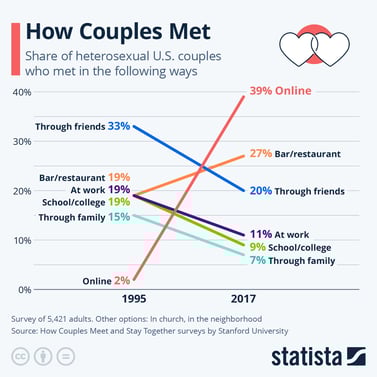
With an unlimited amount of access to people all over the world at the click of a mouse and the touch of our finger tips, we forget the other ways of how couples met one another before it was online and which ways have dwindled.
According to surveys provide through Stanford University between 1995-2017, couples meeting through the internet jumped from 2% to now 39%, which as years progress only get higher.
-
Meeting through friends was once 33% of how couples met in 1995. Since then, around 20% of today’s age meet their significant other through friends. Over 33% decrease within the last 25-30 years.
-
Couples meeting at bar/restaurants in 1995 started at 19% and rose to 27% in today’s age.
-
Couples met at work in the 90s at just 19%, in today’s age, this decreased to 11%.
-
This next one surprised me. Couples that met at school/college made up 19% around 1995. Today’s age: this number has dwindled down to 9%. Personally, with how school systems are now and social media usage to connect with others in a large, concentrated areas, this number should’ve stayed the same or even higher.
-
Couples that met through family took an average of 15% in the 90s, now only 7% in today’s age.
It’s interesting to see these results from over 5,000 adults in the span of 25+ years. With the increasing pattern of couples meeting online, scammers began to use more sophisticated attacks while trying to be undetected.
Why Do People Use Romance Scam Methods?
Sometimes, people use the internet poorly, for malicious intent and financial gain. It’s blindsiding when your intentions are innocent in finding a partner-only to lose more than what you intended on going in with.
Romance scams are not new and in 2025, the FBI got involved warning users about romance scams that are growing in frequency across sites and sophistication with AI. These scams are occurring so frequently, nobody is safe, both men and women are falling victim to strangers and losing funds in the process. Scams rack up millions and millions of dollars from unsuspecting victims annually.
These scams aren’t executed by a single individual looking to financially exploit victims, in today’s age, there are now international crime rings using strategic approaches to build trust then financially exploit victims.
Tactics:
-
Psychological tactics to find you, build trust through rapport.
-
Emotionally entangle victims using AI generated videos and voices thinking it’s a real person.
-
Emotional manipulation to handing over finances to them in hopes to ‘meet in person’.

Losses To Romance Scams
- For romance scams, according to an FDC article, over $547 million in losses were recorded to romance scams in 2021.
- In 2024 that number jumped to $1.3 billion lost to romance scams
Signs Indicate It's a Romance Scam:
- Move very fast emotionally (professes love, destiny, or soulmates within days or weeks) begins to pressure you with urgency, guilt, or threats of disappearing if you don’t comply.
-
Avoid video calls or in-person meetings, or always has an excuse why it’s impossible.
-
Claims to be overseas, in the military, on an oil rig, or working remotely in a secretive job. Doesn’t reveal any verifiable information to you, even if you ask they refuse with constant excuses.
-
Stories don’t quite add up (inconsistencies about their past, job, family, or timelines).
-
Asks for money, gift cards, crypto, or financial help, framed these requests as an emergency that only you can help them. Create repeated crises (medical bills, frozen accounts, business problems) that require your help.
-
Requests secrecy, saying others “wouldn’t understand” or are trying to sabotage the relationship.
-
Push you to move off the dating platform quickly to private email, messaging apps, or encrypted chats, to isolate you from others and mind.
-
Though AI can help these look more convincing, other instances they can use poor grammar or oddly formal/unnatural language that doesn’t match their claimed background.
-
Send very polished or model-like photos that look professional or too good to be true. Always trust your gut if someone or something doesn’t seem right.
-
Claims you’re the only person they trust and tries to isolate you from friends or family.
-
Can attempt to have you invest in crypto as a ‘financial opportunity’ to fit their agenda.
Protect Yourself from a Romance Scam When Actively Talking to People
- Move slowly with emotions.
-
Real relationships develop over time. Be wary of lovebombing from a stranger.
-
Push for video calls, voice calls, and eventually meeting in person matter. Repeated excuses are a warning sign.
-
If they ask for any financial information in an urgent tone, that’s a warning sign. This includes no sending cash, gift cards, crypto, wire transfers, or “investments”.
-
Keep your personal life to a minimum. This includes not sharing your address, financial info, ID photos, work place details, or daily routines.
-
Do not go to a separate location to chat, stay on the dating platform for as long as possible.
-
Verify their identity by reverse-image search profile photos, check names and stories for consistency, and trust evidence over charm.
-
Talk to someone you trust, they may be able to see past the rose-colored glasses for you.
-
If something feels off, act on your intuition.
-
Set and enforce boundaries, you will see how people respect you when a boundary is in place.
-
You don’t owe explanations to someone who makes you uneasy.
If you or someone you know has or may be falling victim to a romance scam, visit ic3.gov to report romance scams to the FBI. Cease contact with scammer immediately.
How Ekaru Helps You Stay A Step Ahead
At Ekaru, we understand romance scams overlap with cybersecurity, financial risk, and employee well-being. We have approaches that can help you and your business react proactively when a romance scam is found within your inbox or online:
-
Security awareness training: Provide regular, plain-language training that includes romance scams alongside phishing, social engineering, and financial fraud. Here we use real-world examples, not scary tactics.
-
Email and messaging protection: We deploy filtering and threat-detection tools that flag suspicious emails, fake invoices, malicious links, and scam-related domains often used in romance and investment scams.
-
Endpoint protection and monitoring: Detect malware, remote-access tools, or credential-stealing software that scammers may try to install during “help me fix this” or “check this link” scenarios.
- Account and identity protection: Enforce MFA, password managers, and breach monitoring to prevent account takeovers that can follow emotional manipulation.
- Policy development and guidance: For your colleagues, create clear, empathetic policies for handling social-engineering incidents, including how and when toreport concerns.
Bottom Line
Romance scams aim to manipulate human emotions for financial gain, and prevention can’t rely on technology alone. By combining personal awareness, healthy skepticism, and clear boundaries through education, security controls, and compassionate response, these steps can significantly reduce both risk and impact.
The goal isn’t to create fear or mistrust, but to empower people to recognize manipulation early, speak up, and stay protected in an increasingly personal threat landscape.
If you’re looking to increase your cybersecurity needs for you and your business for protection against sophisticated socially engineered scams, let’s connect to see if we are a good fit!